McColl 2024: Paleogermaani levisi meren yli idästä?
 Lähetetty: 15 Maalis 2024 05:36
McColl, H., Kroonen, G., Moreno-Mayar, J.V. et al. (preprint).
Steppe Ancestry in western Eurasia and the spread of the Germanic Languages.
https://www.biorxiv.org/content/10.1101 ... 3.584607v1
”Here we integrate multidisciplinary evidence from population genomics, historical sources, archaeology and linguistics to offer a fully revised model for the origins and spread of Germanic languages and for the formation of the genomic ancestry of Germanic-speaking northern European populations, while acknowledging that coordinating archaeology, linguistics and genetics is complex and potentially controversial.”
”We find evidence of a previously unknown, large-scale Bronze Age migration within Scandinavia, originating in the east and becoming widespread to the west and south, thus providing a new potential driving factor for the expansion of the Germanic speech community. This East Scandinavian genetic cluster is first seen 800 years after the arrival of the Corded Ware Culture, the first Steppe-related population to emerge in Northern Europe, opening a new scenario implying a Late rather than an Middle Neolithic arrival of the Germanic language group in Scandinavia. Moreover, the non-local Hunter-Gatherer ancestry of this East Scandinavian cluster is indicative of a cross-Baltic maritime rather than a southern Scandinavian land-based entry.”
Mukana on pari uutta muinaisnäytettä Suomesta: yksi nainen Levänluhdasta, jolla on haploryhmä J1c8a, ja toinen nainen Käldamäeltä, jolla on haploryhmä U5a1f1a.
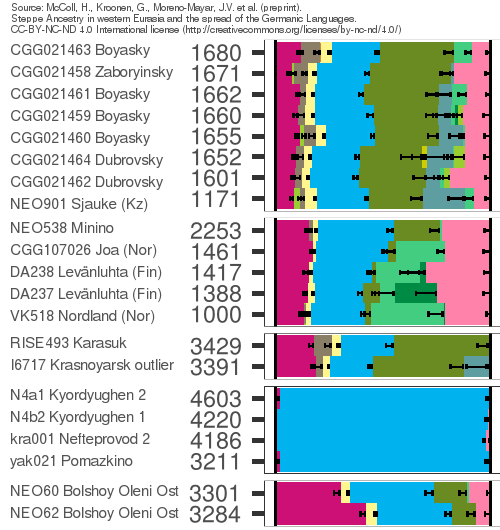
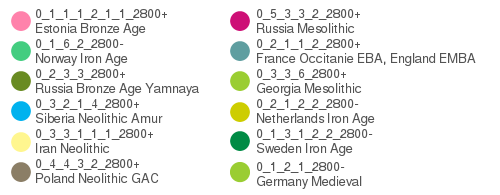
Liettuasta on rautakauden miehiä, joilla on haploryhmää N-L550, ja Venäjältä, Kama-joen varrelta rautakauden miehiä, joilla on haploryhmiä N-L392, N-Z1936 ja R-Z2124. Jälkimmäisten miesten äitilinjojen haploryhmät ovat U4a1d, U4d2, U4b3, C4b, G2a1, F1b1+@152* ja B4c1b2c2. Lisäksi autosomaalisesta perimästä on jonkinlaista dataa oheismateriaalin kuvassa Figure S6.3.2.2.
Steppe Ancestry in western Eurasia and the spread of the Germanic Languages.
https://www.biorxiv.org/content/10.1101 ... 3.584607v1
”Here we integrate multidisciplinary evidence from population genomics, historical sources, archaeology and linguistics to offer a fully revised model for the origins and spread of Germanic languages and for the formation of the genomic ancestry of Germanic-speaking northern European populations, while acknowledging that coordinating archaeology, linguistics and genetics is complex and potentially controversial.”
”We find evidence of a previously unknown, large-scale Bronze Age migration within Scandinavia, originating in the east and becoming widespread to the west and south, thus providing a new potential driving factor for the expansion of the Germanic speech community. This East Scandinavian genetic cluster is first seen 800 years after the arrival of the Corded Ware Culture, the first Steppe-related population to emerge in Northern Europe, opening a new scenario implying a Late rather than an Middle Neolithic arrival of the Germanic language group in Scandinavia. Moreover, the non-local Hunter-Gatherer ancestry of this East Scandinavian cluster is indicative of a cross-Baltic maritime rather than a southern Scandinavian land-based entry.”
Mukana on pari uutta muinaisnäytettä Suomesta: yksi nainen Levänluhdasta, jolla on haploryhmä J1c8a, ja toinen nainen Käldamäeltä, jolla on haploryhmä U5a1f1a.
Liettuasta on rautakauden miehiä, joilla on haploryhmää N-L550, ja Venäjältä, Kama-joen varrelta rautakauden miehiä, joilla on haploryhmiä N-L392, N-Z1936 ja R-Z2124. Jälkimmäisten miesten äitilinjojen haploryhmät ovat U4a1d, U4d2, U4b3, C4b, G2a1, F1b1+@152* ja B4c1b2c2. Lisäksi autosomaalisesta perimästä on jonkinlaista dataa oheismateriaalin kuvassa Figure S6.3.2.2.