Geneetikoilla on mahdollinen havainto samojedien tyyppisestä väestöstä Ob-joen yläjuoksulla,
Novosibirsk Oblastin koillisosassa, ajanlaskun alun jälkeisinä vuosisatoina. Tämä käy ilmi Yusuf Can Özdemirin ISBA10-konferenssissa pitämästä
esitelmästä ja
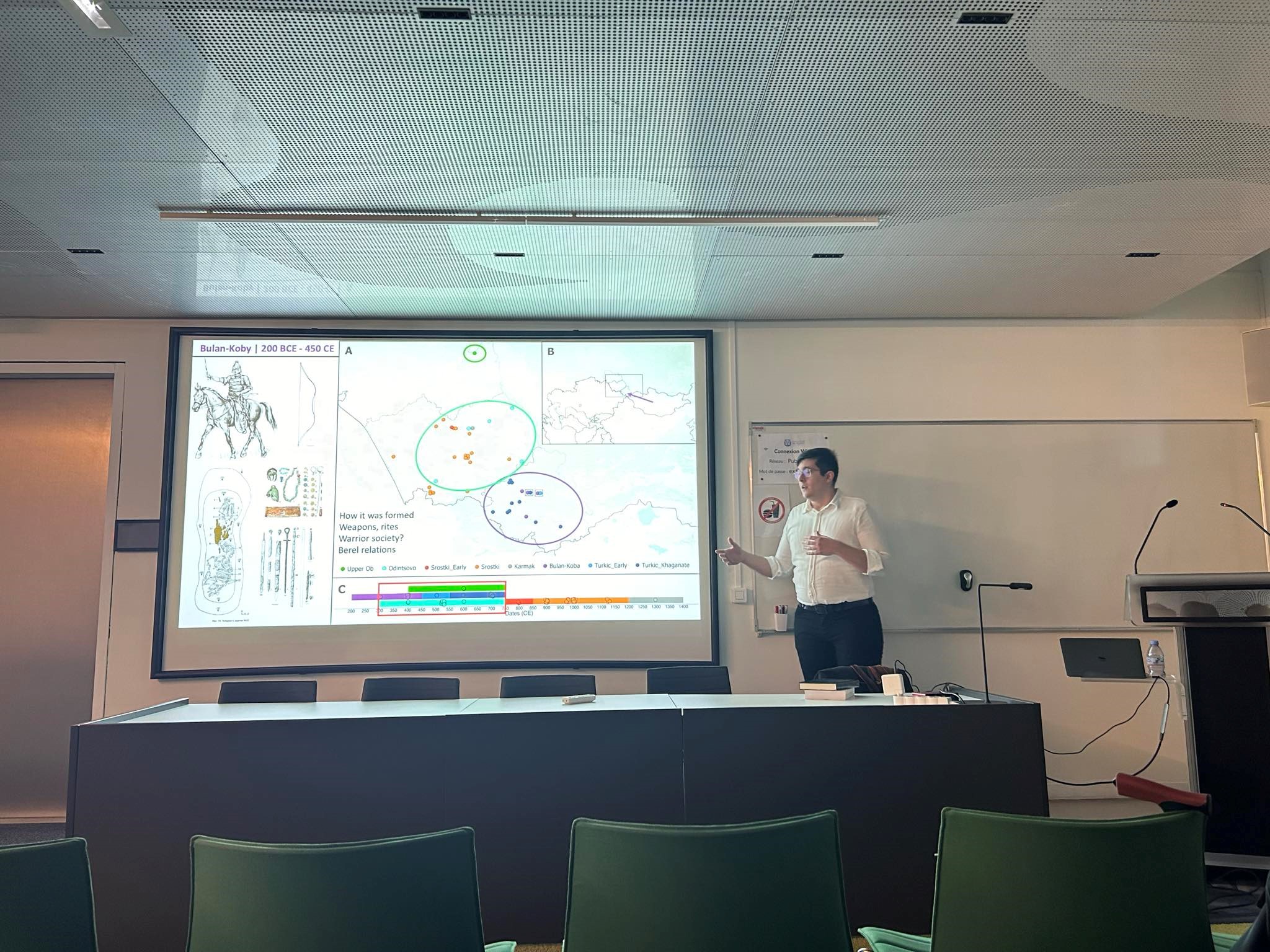
tästä kuvasta, jonka Özdemir on näyttänyt viime vuonna Pariisissa toisessa konferenssissa.
"We present over 100 genomes from the 4th-14th centuries of the Altai region that shed light on complex population histories of the highly mobile Medieval communities in that area. Preliminary results show that the Medieval period inhabitants of the Altai had a heterogeneous genetic profile, being variously related to ancient and modern North Asian, East Asian and Eurasian steppe populations. The results indicate multiple population movement and admixture events, which happened possibly along the political changes in Central Asia.
Bearing high Ancestral North Eurasian ancestry, the Samoyed-affiliated population of the Odintsovo culture was formed by an admixture between their genetically more northern ancestors and the nomadic Bulan-Koby people of the Altai, later assimilating and integrating various other steppe groups. The new data from the Bulan-Koby population, archaeologically connected with the nomadic empires Xiongnu, Xianbei and Rouran, suggest genetic connections with the proposedly Iranian-speaking Saka people. Early Turkic culture developed upon the Bulan-Koby culture in the study area. The data shows that Bronze and Iron Age steppe and East Eurasian precursor populations had genetic influences on later Turkic groups. East Eurasian ancestry increased significantly in the Altai region in the period after the establishment of the Turkic Khaganate. The collapse of the Second Turkic Khaganate heralded new population movements, saw the formation of the Turkic-related Srostki culture and accelerated the Turkification of Samoyedic people of Western Siberia."
Özdemirin mukaan Odintsovon kulttuuri olisi ollut samojedityyppisen väestön ja aron paimentolaisten muodostama ja samojedityyppinen väestö olisi tullut siihen pohjoisempaa Ob-joen varrelta, mihin Özdemirin kuvassa on merkitty vihreä alue nimeltä "Upper Ob". Arkeologian perusteella
Aleksandr Kazakov (2024) esittää, että Odintsovon kulttuuri olisi muodostunut, kun alun perin pohjoisempana vaikuttanut Kulai-kulttuuri levisi etelään Altaille ja muodosti siellä paikallisia alakulttuureja.
"The Odintsovo culture of the forest-steppe Altai existed in the chronological range of the second half of the 4th century – 8th century [CE]. The formation of the Odintsovo culture took place on the territory of the forest-steppe Altai on the basis of the cultural layer of the Fominsky stage of the Altai variant of the Kulai culture. Cultural contacts of the population of the Odintsovo culture with their southern neighbors living in the Altai Mountains, the population of the Bulan-Kobin and Turkic archaeological cultures were extremely weak and episodic and were reflected only in the borrowing of some elements of material culture (inventory complex)."
"[T]he penetration of the Kulai influence into the territory of the forest-steppe Altai is observed earlier than the population change noted by M.P. Gryaznov in the 2nd century AD, caused by a mass migration wave. Such a migration was prepared by long-term and fairly peaceful contacts that took place over a long chronological period (Ivanov, 2000, p. 135; 2016, p. 33). The migration of the Kulai population was not a one-time phenomenon, but was prepared by earlier contacts, which are recorded in archaeological material from the 3rd century BC and are associated with the infiltration of small groups of the Kulai population, represented by representatives of the Novosibirsk variant of the Kulai culture. The presence of features of the Bolsherechensk population of the Scythian-Saka cultural circle in their culture allowed these migrants to coexist quite peacefully with the representatives of the Kamensk and Staroaleyka cultures of the forest-steppe Altai. This peaceful coexistence was also facilitated by the absence of a conflict of interest associated with the ownership of the means of production. The Bochantsevsky stage is the first in the development of the Kulai population of the forest-steppe Altai territory and dates back to the 3rd-2nd centuries BC."
"The second stage is associated with the second migration wave of the Kulai population from the territory of the Tomsk Ob region (Kazakov, 2020, p. 19), the basis of which was the Sarov population, which found in the Novosibirsk Ob region territories already developed by the Kulai people and was forced to move south, to the area of the village of Bolshaya Rechka, where they settled, actively interacting with the local population of the Staroaleyka archaeological culture. This led to the formation of the Fominsk complexes. The Sarov stage dates back to the 1st century BC – 1st century AD. The migration route of the Sarov population passed through large forest areas on the right bank of the Ob River."
"The third stage is represented by the complexes of the Fominsk stage of the Kulai culture. The culture of the Fominsk stage developed on the basis of the culture of the population of the Sarov stage of the Tomsk Ob region. The process of cultural genesis was complex and differed from that in the adjacent territories. In the Blizhnie Elbany region, the Sarov tribes transformed their cultural traditions as a result of interaction with representatives of the Kamensk and Staroaleyka cultures. The preserved monolithic nature of the main culture-forming features allows us to speak of their evolutionary transformation. The established culture of the Fominsk stage turned out to be very resilient, spreading to adjacent territories, leaving there quite striking monuments like the Ust-Abinsk burial ground."
Vesakoski, Salmela ja Piezonka mainitsevat "Uralic archaeolinguistics" -tekstissään sivulla 367, että Kulai-kulttuuri saattaisi liittyä myös nykyisten ugrien esivanhempiin. Sehän olisi luontevaa, jos Kulai-kulttuurin länsiosa liittyisi ugrien esivanhempiin ja itäosa samojedien esivanhempiin. Tosin
tässä kartassa Kulai-kulttuurin länsipuolella on myös Itkul-kulttuuri (nro 2), joka sopisi sijaintinsa puolesta paremmin ainakin mansien ja unkarilaisten esivanhemmille.
"Around 600 BC, along the middle Ob' and its tributaries, the extensive Kulaika cultural complex developed. Connected to the adoption of horses in these more northerly regions, it is characterized by the emergence of rectangular fortified settlements with regular rows of houses inside. The economy in taiga and tundra continued to be based on hunting, fishing, and gathering. [...] From the third century BC onwards, Kulaika groups migrated along the rivers to the fringes of the tundra in the north and far south along the upper Ob' to the Altai foothills (Schneeweiss 2007) (see Figure 20.4, Plate section 1). Kulaika persisted into the fourth century AD and was followed by related traditions throughout the early medieval period up until ca. 800 AD (Parzinger 2006). The Kulaika cultural complex has been associated with Ugric-speaking groups (Molodin 2005)."
Belyayev ja Chindina ehdottavat, että Kulai-kulttuurin väestö olisi valmistanut kupariesineitä ja hankkinut metallia esineiden valmistukseen muiden kulttuurien alueelta. Näitä kulttuureja olisivat olleet pohjoisessa Ust-Polui, etelässä Sargat ja Bolscherechenskaya ja idässä Tagar ja Tsepan. Viimeksi mainittu yhdistyy
Daniel Tabinin julkaisemassa posterissa jeniseiläiseen-perimäkomponenttiin, joka voisi edustaa nykyisten jeniseiläisten eli ketien esivanhempia.
Geneettinen ja arkeologinen todistusaineisto viittaavat siis siihen, että samojedien tyyppistä väestöä olisi voinut asua Ob-joen yläjuoksulla, josta sitä olisi siirtynyt etelämmäksi Altaille ehkä jo 200-luvulla ennen ajanlaskun alkua tai viimeistään ajanlaskun alun jälkeisinä vuosisatoina, ja myös kielitieteessä
Tapani Salminen sijoittaa kantasamojedin Ob- ja Jenisei-joen yläjuoksujen väliselle taigavyöhykkeelle. Tämä suhteellisen pohjoinen sijainti on kuitenkin ongelma, jos oletetaan, että samojedin ja tokaarin välillä olisi ollut yhteyksiä ja nämä yhteydet olisivat muodostuneet mieluummin aikaisin kuin myöhään, kuten esimerkiksi Abel Warries (2022) ehdottaa. Miten tokaari sopisi tähän kuvioon?
PS.
Idimeshev et al. ovat miettineet myös arkeologisia kehityskulkuja, jotka voisi yhdistää samojedikielten leviämiseen etelästä pohjoiseen kantasamojedin hajoamisen jälkeen. Niistä käy ilmi, että Kulai-kulttuurista lähtevä kehityskulku on yksi vaihtoehto, mutta ammattilaiset ovat tunnistaneet yhteensä viisi mahdollista kehityskulkua.
 Lähetetty: 14 Kesä 2025 23:01