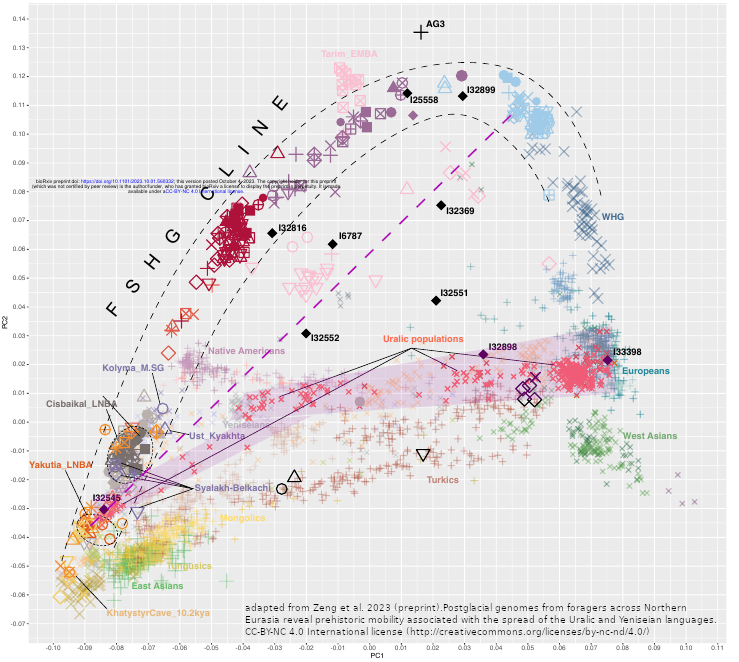
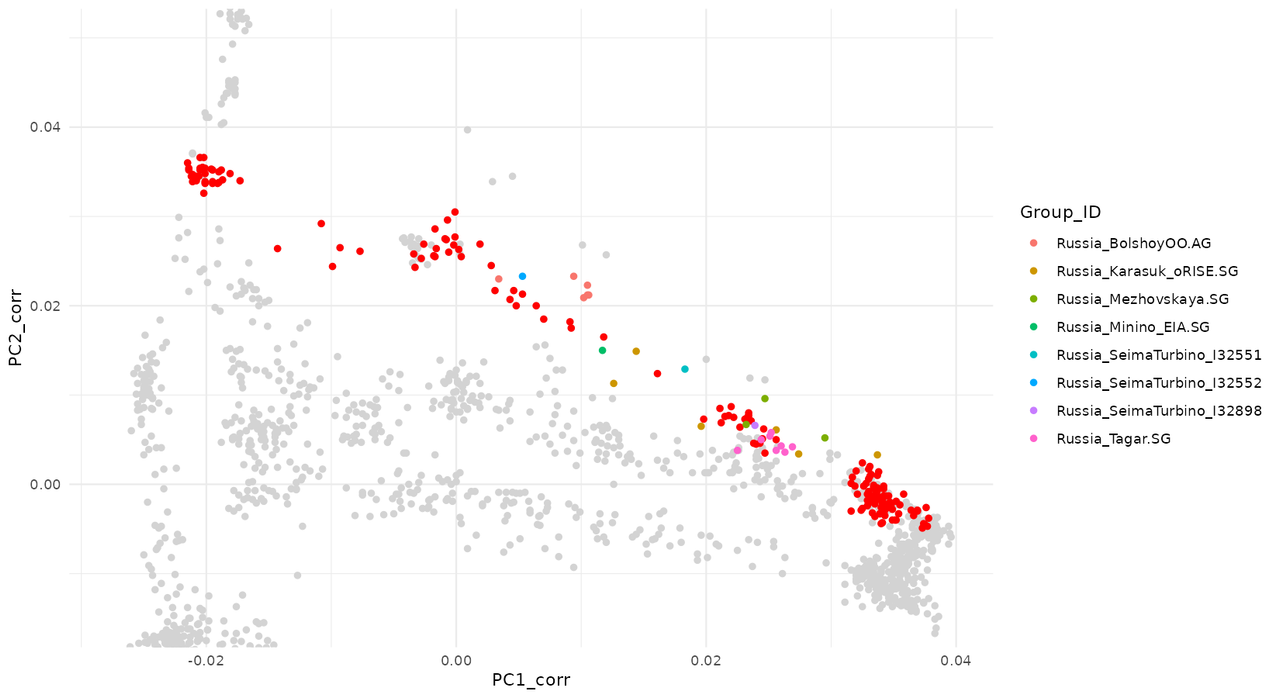
Step 1: The stabilization of the genetic baseline at the Ural Mountains (before c. 1600–1500 BCE)- The basis for the unique, straight genetic cline that links all modern Uralic speakers from Estonians to Selkups, and also some ancient DNA samples possibly associated with Uralic speakers, was probably formed near the eastern slopes of the Ural mountains, at the intersection of the taiga forest belt and the forest-steppe belt.
- Ancient DNA results demonstrate that while earlier samples from Satyga (before 2000 BCE) still had genetically heterogeneous and unstable admixture (see Zeng et al. 2025), later samples from the Mezhovskaya culture (c. 1500–1300 BCE) in the southern Urals seem to represent a three-way admixture (Steppe_MLBA + Yakutia_LNBA + local HG ancestry) which was more stabilized, and one of these samples even falls upon
the Uralic cline.
- The Pre-Proto-Samoyedic language was presumably spoken by a population that was part of this newly formed genetic baseline, and it later came to occupy the easternmost end of the Uralic cline, which continues in a fairly straight line all the way to the Selkups, but bends towards Central Siberian populations as it extends to northern Samoyedic speakers.
Step 2: The emergence of the Samus-Kizhirovo metalworking tradition (until c. 1600–1500 BCE)- Simultaneously with the genetic stabilization, a highly advanced, technological and metallurgical synthesis occurred on the eastern slopes of the middle Urals, giving rise to the Samus-Kizhirovo metalworking tradition, characterized by distinctive "false-eared" celts (categories K-52 and K-54).
-
S.V. Kuzminykh (2011) demonstrates that the roots of Samus-Kizhirovo metallurgy did not originate in the Samus culture on the Ob river, but developed in the Trans-Urals — specifically highlighted by the synchronous Shaitanskoye Ozero II sanctuary context of the Koptyakov culture.
- This weapon technology, and a cultural association with Indo-Iranian speaking groups, provided the necessary basis for a demographic expansion, allowing Pre-Proto-Samoyedic speakers to launch a highly dynamic eastward movement across Western Siberia.
Step 3: The eastward expansion within the Andronoid horizon and the colonization of the Ob river (c. 1500–1400 BCE)- The Pre-Proto-Samoyedic speakers moved east across Western Siberia as part of the expanding Andronoid cultural horizon, carrying the new Samus-Kizhirovo bronzes with them.
- Upon reaching the Upper Ob river and the Tomsk region, this incoming wave came into contact with the local Samus culture, turning the area into a syncretic cultural hub, which was probably similar to the cultural hub at Shaitanskoye Ozero.
- The area of the Samus culture also includes Tatarka Hill, where the earlier population had almost unadmixed Yakutia_LNBA ancestry, so the incoming Samoyedic speakers may have been drawn to that area because part of their own ancestry may also have originated there.
- This migration of Andronoid groups caused a radical shift in burial practices: the older, local Samus customs were replaced by Andronoid-style burials (at least according to Google AI, but better check this in scientific articles).
- This transition suggests that a new population arrived in the area, and it also explains the craniological findings by A. Kozintsev, who identified "the earliest Uralic-looking skull type" within the burials of the Yelovka culture (c. 1400 BCE), which apparently replaced the Samus culture (better check this).
- However, genetic data from
Özdemir et al. (2026) shows that the ancient, local hunter-gatherer ancestry of the Western Siberian forest-steppe persisted in the Upper Ob region well into the Common Era, but it was most likely admixed with other genetic ancestries, such as Steppe_MLBA and Yakutia_LNBA.
- Özdemir et al. also tentatively suggest that a population carrying a considerable share of this local hunter-gatherer ancestry spoke a Samoyedic language in the Upper Ob culture.
- This may imply that the expansion of the Andronoid cultural horizon triggered a language shift among some of the local Western Siberian populations who remained on the Upper Ob, and they may have switched their language to Samoyedic.
Step 4: Reaching the Yenisei and the Altai-Sayan (after c. 1400 BCE)- From the Yelovka culture, the Pre-Proto-Samoyedic wave may have continued further east, crossing the Yenisei river.
- According to S.V. Kuzminykh (2011), the metal finds at Tatarka Hill show clear influences from the forest-steppe Andronoid cultures of Western Siberia, while the expansion of Samus-Kizhirovo metallurgy also reached the Altai-Sayan and Baikal regions (as far east as the Tunka basin).
Step 5: The contact, assimilation, and substrate influence on Pre-Proto-Tocharian (c. 1400–1000 BCE)- Having established themselves in the immediate vicinity of the Minusinsk Basin, the Pre-Proto-Samoyedic speakers possibly came into linguistic contact with the speakers of Pre-Proto-Tocharian (the descendants of the Afanasievo culture).
- A fairly large number of these Samoyedic speakers may have been assimilated into the Tocharian community, and their language may have influenced Pre-Proto-Tocharian quite heavily.
- As detailed by Abel Warries, this specific Pre-Proto-Samoyedic substrate explains the significant foreign influence on early Tocharian, including the changes in pronunciation and grammar.
- Because Tocharian entered into contact with Old Steppe Iranian after the contact with Samoyedic, this relative linguistic chronology dictates that the Samoyedic contact phase probably took place before 1000 BCE.
- The Andronoid/Yelovka-derived expansion provides an archaeologically viable, 400-year window for this intense substrate shift to occur; the later Iron Age Kulai culture simply arrives too late into the Altai region.
Step 6: Later divergence- Samoyedic speakers may have remained rooted in the Upper Ob region (within the subsequent Irmen culture, c. 1400–800 BCE) or near the Altai-Sayan, north (or even east) of the Karasuk culture.
- It was only later that the northern branch of Samoyedic began to expand from this southern area toward the far north along the archaeological chains described by Asap Idimeshev, eventually absorbing the remote Arctic substrates and displacing the northern Samoyedic groups (like Nganasans) off the Uralic genetic cline.